|

|
FAVORABLE DIAGNOSTIC
PROPERTIES OF COUGH-INDUCED LEAK POINT PRESSURE COMPARED WITH VALSALVA
LEAK POINT PRESSURE
|
|
| |
|
|
|
|
|
|
|
|
| |
|

|
Authors:
|

|
H Siltberg*, A Victor#
and G Larsson*
|
|
| |
|
|
|
|
|
|
|
|
| |
|
|
|
Institution:
|
|
*Department of Women's
and Children's Health, Section for Obstetrics and Gynecology, University
Hospital and #Medical Products Agency, Uppsala, Sweden
|
|
| |
|
|
|
|
|
|
|
|
| |
|
|
|
| |
|
|
|
|
|
|
|
|
| |
|
|
|
|
| |
|
|
|
|
|
|
|
|
| |
|
|
|
|
|
| |
|
|
|
|
|
|
|
|
Background:
Methods to measure abdominal leak point pressure vary with respect to mode of
provocation, method used to detect leakage, and amount of bladder filling. Altering
one or more of these factors might influence the sensitivity of the test as
well as its ability to differentiate between patients and healthy subjects.
Aim: The aims were 1) to investigate whether bladder volume affects the detection
rate of incontinence (sensitivity) or the level of leak point pressure when
the Cough Induced Leak Point Pressure measurement method (CILPP)-based on coughs
for provocation and urethral electrical conductivity to detect leakage-is used;
2) to study if the method has the ability to differentiate between patients
with a history of stress incontinence and controls without such a history and
3) to compare these findings regarding CILPP with the corresponding findings
for Valsalva Leak Point Pressure (VLPP).
Material and Methods:
The study was an open, randomized, controlled clinical trial of cough induced
and Valsalva leak point pressure measurements at different bladder volumes where
40 female patients with a history of stress incontinence and 11 women without
current complaints of stress incontinence were included. Leak point pressure
measurements were performed at two different bladder volumes: first at 200 ml
and then at 90% of the largest single voided volume as determined from the frequency/volume
chart, or at 90% of maximum cystometric capacity, whichever was reached first.
Mean volume at 90% of capacity was 451 ml (range 225-810 ml). The order of testing,
i.e. whether the testing started with cough provocation or Valsalva maneuver,
was randomized. For the individual subject, the order of testing was the same
at both volumes. Urinary leakage was detected by measuring distal urethral electrical
conductance (DUEC) with a 7F Silastic probe placed in the urethra (UEC-meter).
The increase in abdominal pressure above the baseline value during provocation
was recorded using a microtip catheter placed in the fornix of the vagina (Figure
1). To determine CILPP, subjects were asked to cough with gradually increasing
exertion until leakage was detected. To determine the Valsalva leak point pressure,
subjects were asked to bear down-as if trying to push something out of the vagina-until
leakage was detected by the UEC-meter.
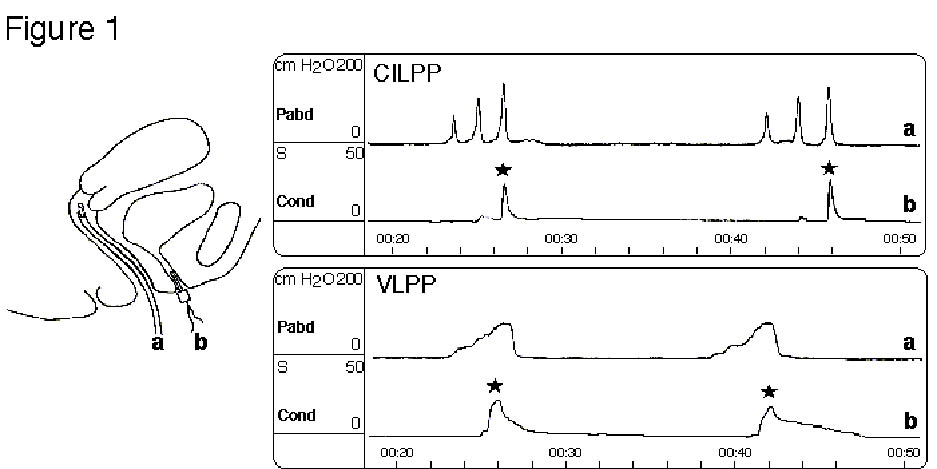
The practical set-up
to determine CILPP and VLPP with the microtip catheter (a) placed in the vagina
and the UEC-meter (b) in the urethra. Below are copies of leakage (H) and pressure
recordings. Note the stepwise increase in cough strength. CILPP was defined
as the mean of the lowest single pressure that produced leakage and the highest
single pressure recorded without concomitant leakage. The lowest pressure producing
leakage in a series of three Valsalva maneuvers defined the VLPP.
Results:
CILPP verified leakage in 37/40 and 38/39 patients at 200 ml and at 90% of maximum
bladder capacity, respectively. The corresponding figures for VLPP were 29/40
and 37/39. Thus at 200 ml, the sensitivity of CILPP was significantly higher
than the sensitivity of VLPP. At 200 ml, the specificity of CILPP was 0.73 (8/11)
and the overall accuracy 0.88 (45/51). The corresponding figures for VLPP were
0.82 (9/11) and 0.75 (38/51). Increasing bladder volume to 90% of maximum capacity
did not alter the specificity of either measure. Raising the volume did, however,
increase the overall accuracy of both CILPP and VLPP to 0.92. Mean pressure
levels at leakage for CILPP were significantly lower at 90% of maximum bladder
capacity than at 200 ml: 90.7 cm H2O compared with 103.2 cm H2O (p=0.0085).
VLPP levels were significantly lower than mean CILPP levels at corresponding
volumes, but there was no statistically significant difference between VLPP
levels at 200 ml and 90% of bladder capacity: 72.5 cm H2O and 68.6 cm H2O respectively.
Conclusion:
The sensitivity of CILPP is high over a wide range of bladder volumes whereas
VLPP requires a large bladder volume to attain an acceptable detection rate.
The specificity of CILPP and VLPP allows differentiation between patients with
stress incontinence and controls.